The “Earth” a Case of Semantics

This post is from Chapter 3 of my forthcoming book, Noah’s Flood and the Philosophies of Men.
There is a very simple statement concerning the Flood and God’s Word on the internet website Answers in Genesis, which seems to be the major voice of conservative, young-earth Christians: “This is ultimately about the authority of God’s word, which plainly teaches that the Flood of Noah was global in extent.” Another statement on that website also proclaims, “The final evidence of the universal Flood is the Rainbow Covenant. Not only does it confirm the supernatural uniqueness of this global catastrophe, it proves its universality. This divine promise was made to the earth itself.” Furthermore, “Whether the Flood of Noah was global or local in extent is a crucial question. This is because ultimately what is at stake is the authority of all of God’s word.”1
I believe God’s word, but I do not stake my faith in Him and His Word on the flimsy notion that “the authority of all of God’s word” is ultimately based on whether or not there was a universal flood. I do not believe for one minute that if Noah’s Flood was not universal, all of God’s Words would be made null and void.
I believe God’s word, but what I do not believe is that His word “plainly teaches that the Flood of Noah was global in extent”. Critically, we can ask a simple question: are the words “global” and/or “universal” even among God’s words? Are they in the Bible? The answer is: No, the words “global” and “universal” are not found in the Bible. So, how could God’s word “plainly” teach that the Flood was global when the word “global” isn’t even among God’s words?
If the words “global” and “universal” are not among God’s words, then they must be derived from the philosophies of men. We are also told at the Answers in Genesis website that, “In the depths of the world’s ocean, catastrophe struck. The seafloor suddenly broke open in the middle, while the edges began dividing into the mantle below. The crack in the seafloor spread around the globe.”2 Where is that story told in the words of God? Nowhere.
Here’s what the relevant scripture actually says (Genesis 7:11): “In the six hundredth year of Noah’s life, in the second month, the seventeenth day of the month, the same day were all the fountains of the great deep broken up, and the windows of heaven were opened.”
We are never told in the scriptures what happened when the “fountains of the great deep [were] broken up”. The only water mentioned in the scriptures came in the form of rain (Genesis 7:12): “And the rain was upon the earth forty days and forty nights.” Furthermore Genesis 8:2 states: “The fountains also of the deep and the windows of heaven were stopped, and the rain from heaven was restrained…” These verses never state that any water came from inside the earth; anyone who says anything differently is simply stating the philosophies of men.
So, Genesis 7:12 says that, “…the rain was upon the earth forty days and forty nights.” Today, there are two definitions of “earth”: 1. the substance of the land surface, soil; and 2. the planet on which we live, the World. Such has not always been the case. The word “earth” is an Old English, Germanic, word: eorpe, meaning “ground”, “soil”, or “land”. The word “planet” derives from the Greek word planetes, meaning “wanderer”. The name reflects how planets, appear to wander among the other, “fixed” stars. Those wandering stars were named after Greek and then Roman gods: Mercury, Venus, Mars, Jupiter, and Saturn. The name “Earth” as a planet certainly does not fit with the names of the other planets, nor does the term “planet”, as a “wandering star” fit the earth.
The concept that the earth is a planet, whose orbit around the sun is between that of Venus and Mars, was not proposed until Nicolaus Copernicus wrote his 1543 book, De Revolutionbus Orbium Coelestium (On the Revolutions of the Heavenly Spheres). However, the Copernican heliocentric theory was not widely accepted for another two hundred years. Galileo Galilei championed the heliocentric theory in his 1632 book, Dialogue Concerning the Two Chief World Systems, Ptolemaic and Copernican. He was tried for heresy before the Roman Inquisition in 1633 because the heliocentric model contradicted accepted Biblical interpretations.
The scripture at issue was Joshua 10:13: “And the sun stood still…until the people had avenged themselves upon their enemies…the sun stood still in the midst of heaven, and hastened not to go down about a whole day.” People for hundreds of years interpreted that scripture as proof that the sun orbited the earth (or some version of that idea), rather than the other way around. Galileo was convicted of heresy and spent the last nine years of his life under house arrest. It wasn’t until the late eighteenth century that the Catholic Church finally allowed the heliocentric model to be taught, and it wasn’t until 1992 that Pope John Paul II finally admitted that Galileo was right after all and offered a formal, public apology.
The writers of the King James Version of the Bible, which was first published in 1611, certainly did not accept the Copernican notion that the Earth was the third planet from the sun, even if it had been conceded for around one hundred years that the earth was round—being round did not make it a planet. The King James Version of Genesis 7:4 states, “For yet seven days, and I will cause it to rain upon the earth forty days and forty nights; and every living substance that I have made will I destroy from off the face of the earth.” The Vulgate version of Genesis was a fourth-century Latin translation by Jerome from the Hebrew (or Aramaic) Masoretic Text. By the 13th century, the Vulgate, designated versio vulgata (the “version commonly used”) or vulgata for short, was commonly used. The Vulgate version of Genesis 7:4 states, “adhuc enim et post dies septem ego pluam super terram quadraginta diebus et quadraginta noctibus et delebo omnem substantiam quam feci de superficie terrae.”
We see the word “earth” used twice in the King James’ English version of that verse. The Latin word terram (for the first “earth” in the Vulgate verse) means “ground.” According to the online dictionary, Goong.com, “The Latin word ‘terrae’ [the second “earth” in the verse] translates to ‘of the earth’ in English. It’s the genitive singular form of ‘terra,’ which means ‘earth’ or ‘land.’ While ‘terra’ itself can refer to the planet Earth, ‘terrae’ is more specifically used to denote something belonging to, or pertaining to, the earth…[it is] often used in contexts referring to land, soil, or ground. The term ‘terra’ originates from Latin, meaning ‘earth’ or ‘land.’ The suffix ‘–ae’ indicates the genitive singular form in Latin, effectively translating to ‘of the earth’ or ‘belonging to the earth.’”3
The Hebrew word הָאָֽרֶץ׃ (hā·’ā·reṣ) means “earth” or “land”, so both the Vulgate and King James Version are correct in translating the word as “earth”, but equally correct would have been to translate the term as “land”, but not as “the Earth”, meaning our planet. In no case, throughout the Flood story is the Hebrew word ארץ (eretz), which usually means “the Earth”, used. Even if it had been, the ancient Hebrew notion of the Earth, like most everyone else at the time, was that the Earth was a flat plane, often envisaged as floating on, or within, water, and therefore, easily covered by a deluge.
The Babylonian concept of the Earth involved lots of water. During the seventy-year-long captivity of the Israelite intelligentsia in Babylon, they were greatly influenced by Babylonian philosophy. That philosophy included the Sumerian “Abzu”, a cosmic freshwater ocean that surrounded the Earth, which was created in its midst, with water above and below. A bubble of breathable air clung to the Earth’s surface. The gods built gates, or windows, in the sky, which they could open to let rain fall onto the earth. Rivers originated in springs, or fountains, from the vast underground ocean.4

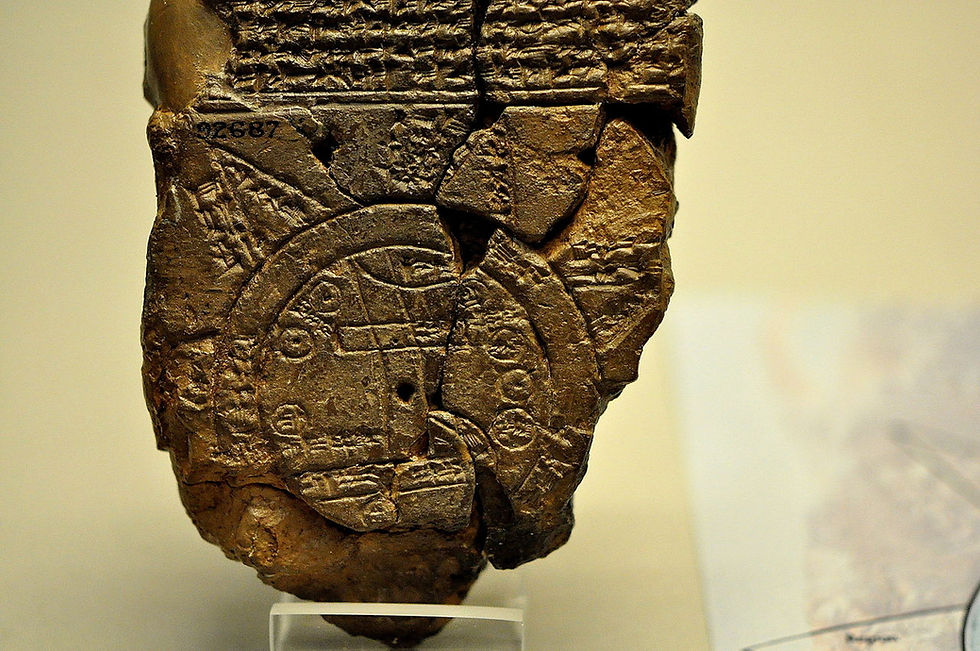
My drawing here is adapted, with additions and deletions, from a map by Carlos Gutiérrez Sáenz in his work: “The Primal Error: Fall, Curse, and Doom; Enkidu and Gilgamesh” [in German], 2002.5 This map follows, in Sáenz’s manuscript, an interpretive drawing of the “Babylonian Map of the World”6, which was drawn and labeled in Akkadian cuneiform on a clay tablet, likely dating from the late 8th or 7th century BC (the photo at the begining of this post). That map is the oldest acknowledged depiction of the then known world. The tablet was discovered by Hormuzd Rassam in the ancient Mesopotamian city of Sipper, now in the Baghdad vilayet, 37 miles north of Babylon on the east bank of the Euphrates River. It was acquired by the British Museum in 1882 (BM Inv. No. 92687), and the text was first translated in 1889 by Felix Ernst Peiser.7
This Babylonian world view was very limited in scope. Mesopotamia means “in the middle of the rivers”, the rivers being the Tigris and Euphrates. The mountains, the “pillars of the sky”, were the Mountains of Lebanon (around 550 miles to the west) and the Mountains of Zagros (some 300 miles to the east). So, the entire Babylonian world was only around 850 miles across. The “salt sea” to the west of Lebanon would be the Mediterranean and “salt sea” to the east may be the Caspian Sea.
Therefore, it is highly likely that the Hebrew term and concept, in Genesis 7:11, מַעְיְנֹת֙ (ma‘·yə·nōṯ) רַבָּ֔ה (rab·bāh) תְּה֣וֹם (tə·hō·wm) “fountains of the deep”, connected to a vast subterranean water source, was derived from Sumerian cosmology, literally centered in the water-world of Abzu. However, note that in Genesis chapter 7, the only actual source of water causing the Flood came in the form of rain. One wonders if some Hebrew scholar, in relating the traditional oral story of the flood, added the “fountains of the deep”, recalling his Babylonian training (brainwashing?) that those fountains were another great source of water.
We’ve come a long way from the mythical Sumerian god, Abzu. Or have we? Now, a modern charlatan is leading his (apparently numerous) followers to worship at the throne of this false god—claiming that the water causing Noah’s Flood came from the “fountains of the deep” opening onto a vast underwater ocean—indeed, claiming that the entire center of the earth is filled with water! This nonsense was written by Dean Sessions and published in his books, Universal Model, in 2020.8 Sessions has no scientific education and apparently has no knowledge of the fact that the Sumerians were teaching these same cosmic myths thousands of years ago.
In his book, Sessions quoted Genesis 7:11, “In the six hundredth year of Noah’s life, in the second month, the seventeenth day of the month, the same day were all the fountains of the great deep broken up, and the windows of heaven were opened.” He then stated, “These ‘fountains’ are the hydrofountains first introduced in the Hydroplanet Model.”9 Sessions entire set of books and all his lectures are balanced on the pinpoint of one single subsection of one single Old Testament scripture: “fountains of the deep”. It turns out that the word “hydrofountains” is also not part of God’s word. That idea is entirely the insane philosophy of one man and not of God.
Even if we look at the Greek world view from about the same time period as the Israelite liberation (520 BC), the world was still a very small place, being only around 3,900 miles in diameter; thus, covering an area of about 12,000,000 sq miles, or 6.1% of the Earth’s actual total surface of some 196,900,000 square miles.

This map is redrawn from the World according to Hecataeus (c. 550–480 BC). Hecataeus of Miletus (c. 550 – c. 476 BC), son of Hegesander, was an early Greek historian and geographer. The original map no longer exists but my drawing is taken from modern scholarly reconstructions, based on surviving fragments and contemporary descriptions of the original. Specifically, this version appeared in Cram’s 1901 Atlas of the World.10
In the King James Version of the Bible, Genesis chapter 6 mentions the “earth” fourteen times. The two Hebrew words in that chapter (used ten times and only implied in the Hebrew one additional time) translated as “earth” are: הָאָ֔רֶץ (hā·’ā·reṣ), meaning “earth”, or “land”; and בָּאָ֖רֶץ (bā·’ā·reṣ), meaning “on the earth”. The Hebrew word הָֽאֲדָמָ֔ה (hā·’ă·ḏā·māh), meaning “ground”, or “land”, appears twice and is implied one other time. For example, in Genesis 6:20, the Hebrew does not include הָֽאֲדָמָ֔ה (hā·’ă·ḏā·māh),11 but it just says “crawling creature” not “creeping thing of the earth”, which was added in the King James Version.
Furthermore, from Genesis 7:4, all the way to Genesis 9:1 where “…God blessed Noah and his sons, and said unto them, Be fruitful, and multiply, and replenish the earth”, the Hebrew word that has been translated as “earth” in the King James Bible is הָאָ֔רֶץ (hā·’ā·reṣ), meaning “earth” or “land”, or עַל־ (‘al-) הָאָ֔רֶץ (hā·’ā·reṣ), which means “upon the earth”.12 Here, the word “earth” should still be understood as “earth” meaning the “land” and never the entire “Earth”. The distribution of Noah’s descendants across the Hecataeus map will be addressed in another chapter.
Mike Heiser has pointed out other Biblical citations where “the whole (כֹּל) land (אֶרֶץ)” certainly does not mean the entire Earth, or globe as we know it. For example: Genesis 13:9 (Abraham to Lot), “Is not the whole (כֹּל) land (אֶרֶץ) before you? – No, Lot wasn’t looking at the entire globe, nor could he.” Genesis 41:57, “And the people of all (כֹּל) the earth (אֶרֶץ) came to Egypt to buy grain from Joseph . . . Did everyone in the Mediterranean come? China? India? North America? Again, the hyperbole is obvious.” Judges 6:37 (Gideon), “Behold, I will put a fleece of wool on the threshing floor. If there is dew on the fleece only, and it is dry on all (כֹּל) the ground (אֶרֶץ), then I will know that Thou wilt deliver Israel through me – “all the ground” refers to a small portion of land in the area where Gideon was.” 2 Samuel 18:8, “For the battle there was spread over the whole (כֹּל) land (אֶרֶץ) … (This battle didn’t take place in every portion of the entire globe).”13
Heiser continued, Consider, “…Genesis 10 as the context for the flood account asking, What is ‘the world’ to the biblical writer? Answer: Genesis 10. That chapter lists out all the nations descended from Noah’s sons. They cover only the Mediterranean and ancient Near East. There is no knowledge of Australia, China, Japan, North America, South America, etc. Hence…take the language of Gen 6-8 and simply argue that, to the writer, the account covered all the known land masses, but the real-time event wasn’t global…The lesson here is that those who prefer a global flood reading of Gen 6-8 need to avoid calling those who don’t ‘unbiblical’ in their position, or arguing ‘from science against the Bible’ when taking a local-regional view. The above has nothing to do with science. It’s a text-based approach.”14
The bottom line here is that God’s Word never once referred to Noah’s Flood as covering the entire Earth, the planet, as we know it, or even the flat disc Earth, ארץ (eretz), as the ancient Hebrews knew it. Rather, all the discussion of the rain and the flood referred to earth, land, soil, ground, dirt. Thus, when the rain came, it covered the ground to a height of “fifteen cubits”. Any notion that the Genesis story is one of a world-wide, global, universal flood is simply the philosophies of men, which, in my opinion, do nothing to enhance a person’s faith, but rather throw up a barrier to a thinking person trying to develop or maintain faith.
Trent Dee Stephens, PhD
References
1. Snelling, Andrew A., and Ken Jam, Was the Flood of Noah Global or Local in Extent? 2013; from The New Answers Book 3, chapter 6; answersingenesis.org/the-flood/global/was-the-flood-of-noah-global-or-local-in-extent
4. Brown, Joshua, Sumerian Mythology: A Deep Guide into Sumerian History and Mesopotamian Empire and Myths, Pisces Publishing, 2022
5. drive.google.com/file/d/1gKKedwPM8RTGjyxzuojd-lBh1B8bNmth/view, p. 72; Creative Commons
6. also Imago Mundi or Mappa mundi, p. 71
7. Peiser, Felix Ernst, Zeitschrift für Archäologie, Journal of Archaeology, 1889, 361-370
8. Sessions, Dean, Universal Model, Volume 2, Digital Legend, SLC, Utah, 2020, p. 493
9. Ibid
10. Cram, George Franklin, Atlas of the World, Ancient and Modern: new Census Edition-indexed, editorially assisted by Eugene Murrary-Aaron, published by George F. Cram, New York, Chicago, 1901.
11. Bible Hub
12. Ibid
13. Heiser, Michael S., drmsh.com/argue-biblical-text-local-regional-flood-instead-global-flood, 2018
14. Ibid


Comments